
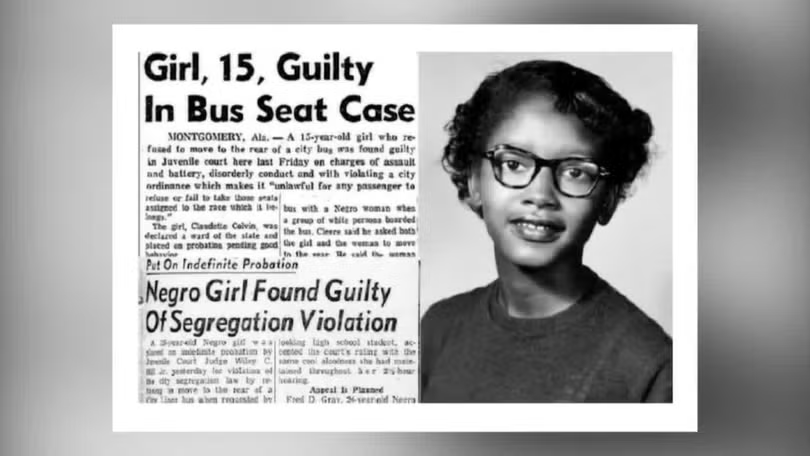
Black History Month invites us not only to celebrate familiar icons, but to revisit the stories that were overlooked, delayed, or intentionally pushed aside. One of the most important of those stories belongs to Claudette Colvin, a 15-year-old Black girl whose courage helped ignite the modern Civil Rights Movement—long before Rosa Parks became a household name.
On March 2, 1955, nine months before Rosa Parks’ historic stand, Claudette Colvin refused to give up her seat on a segregated Montgomery, Alabama bus. Inspired by what she had learned in school about Harriet Tubman, Sojourner Truth, and the Constitution, Colvin later said she felt as if history itself was pushing her down into that seat. When police dragged her off the bus, she was arrested, handcuffed, and charged with violating segregation laws.
 Colvin’s act of resistance mattered deeply. She became one of the four plaintiffs in Browder v. Gayle, the federal court case that ultimately declared bus segregation unconstitutional in 1956. While the Montgomery Bus Boycott brought national attention to civil rights, it was Browder v. Gayle—with Colvin’s testimony—that legally ended bus segregation. Her role was not symbolic; it was foundational.
Yet for decades, Claudette Colvin’s name was largely absent from mainstream Civil Rights history. The reasons why speak volumes about the era—and the movement itself.
Civil rights leaders at the time believed Colvin was not the “right” face for a national campaign. She was young, dark-skinned, outspoken, and later became pregnant as a teenager. In a society shaped by respectability politics, movement leaders feared that white America would dismiss her story or use it to discredit the cause. Rosa Parks, by contrast, was older, married, employed, and already active in the NAACP. She fit the image leaders believed would gain broader public sympathy.
This contrast does not diminish Rosa Parks’ bravery—her resistance was real, deliberate, and courageous. What makes Claudette Colvin different is that she acted without preparation, protection, or a movement ready to catch her. She was not chosen; she chose herself. Her defiance was raw, youthful, and unfiltered, reminding us that history is often pushed forward by people who never intended to be heroes.
Claudette Colvin’s legacy is especially powerful during Black History Month because it expands our understanding of who creates change. It challenges the idea that leadership must look a certain way or arrive at the “perfect” time. Her story also forces us to confront how sexism, colorism, and class shaped whose courage was celebrated—and whose was sidelined.
Today, Colvin’s contributions are finally being recognized, not as a footnote, but as a pillar of the Civil Rights Movement. Her story reminds us that progress is not only built by famous names, but by fearless individuals—sometimes teenagers—who refuse to move when injustice tells them to.
Claudette Colvin didn’t wait for permission to make history. And Black history is richer, truer, and more honest when we remember her.


